Friday, December 11, 2015

A Cuban Delegation

I had the privilege of leading a group of U.S. delegates on a People to People trip to Cuba. The goals of the trip were to learn about the Cuban culture and their health care system and outcomes, with particular emphasis on women’s health and the role nurses play within the system. Our group of delegates was made up of nurses, physicians, psychiatrists and a judge, representing clinical practice, education, research and legislation. The depth and breadth of what we experienced and learnt far exceeds the time we spent in Cuba. Prior to our trip, we reviewed articles written by Cubans and non-Cubans, and during our trip, we listened to and absorbed knowledge from Cuban leaders, physicians, nurses, politicians and guides. We witnessed firsthand the different levels of health care that make Cuba successful in increasing life expectancy, eliminating HIV, decreasing maternal and infant mortality rates and decreasing amputations due to diabetes. This particular blog will reflect on the group’s shared impressions and learning experiences. Here are a few shared insights from our group:
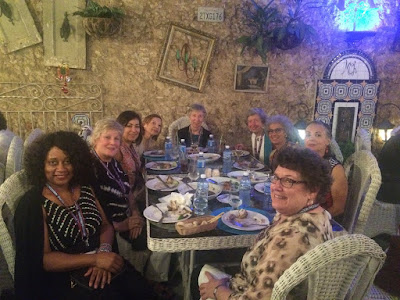
  • The hallmarks of the entire Cuban political system are focusing on free education for everyone (mandatory until 9th grade), preventative health care and insuring gender equity in all systems.
  • Three levels of health care at community, province and specialty hospitals based on individual needs, guarantee access, prevention and better health outcomes.
  • Cuba spent 10% of their GDP on health, as compared to 17% for the U.S., and both countries have similar life expectancy (78 years) and infant and maternal morbidity and mortality rates.
  • Cubans have a very strong sense of identity tied to their country and a great deal of demonstrated pride in their achievements in spite of limited resources.
  • Everyone we met was excited and hopeful about a more normalized, reciprocal relationship with the U.S.
  • Health diplomacy, sending doctors and nurses to work in other countries, is used as a means to establish solidarity, to promote good will, to generate revenues for the country, and when needed, to help other countries as humanitarian gestures.
  • Cuban family nurses and physicians live in the neighborhoods they serve and personally know most of their patients. They assess individual risk levels, they increase compliance and they promote self-care. Together, health care professionals and patients are responsible for health care.
  • Intersectional collaboration and integrated services are values shared by all.

I am grateful to the members of the delegation who traveled with me, experts and leaders in their own fields, engaged and totally present throughout our adventure.


Thursday, November 12, 2015

Sigma Theta Tau Award: Nurses Make a Difference

I was honored to receive the Nell J. Watts Lifetime Achievement Award from Sigma Theta Tau during their 43rd Biennial Convention in Las Vegas, NV (November 7-11, 2015). This award meant a great deal to me for a number of reasons.

First, because I am honored to carry the namesake of a very action oriented, voiced leader, Dr. Nell Watts, whom I admired not only from afar, but had the honor to be in her presence and audience on numerous occasions.

Second, because it was humbling to be among a distinguished and transformative group of colleagues and award recipients, in particular, my dear friend and colleague from Colombia, Nelly Garzón Alarcón, who is a former ICN president and is an incredible Latin American leader.

Third, because I am receiving this award from Sigma Theta Tau, a powerful organization that has numerous members and chapters in  many countries – who do and can have a strong voice to make a difference, particularly for the gender inequities and injustices that nurses suffer from worldwide.

This is the best time for nurses to make an impact for care providers and care receivers. We are better educated, we develop the knowledge and evidence for quality care and we have individual and collective voices that could make us, 20 million globally, an incredible force for equal access and for quality care.

In the time it takes you to read this blog, 5 women will have died from pregnancy complications that could have been prevented, 5 girls will have been forced and sold into marriage, 1 girl will be trafficked into servitude and many nurses will be hired to work in sub-optimal environments and paid 25% of what they are entitled to – and we can make a difference in all of these areas.

Devaluation and under compensation do not only affect nurses’ sense of wellbeing. It influences nurses’ abilities to function up to their full capacities in providing quality care for people, especially those who are the most vulnerable. 

By remembering our social mission and our contract with society for providing equitable and quality care for all, regardless of gender, culture, heritage, race and educational and economic abilities, we can make a difference.

We must recognize inequities, refuse to put up with oppressions and use our strong collective voice to empower, to lead, to partner and to deliver care up to our full capacities. We must continue to refuse, as a collective, to be oppressed, devalued and undercompensated. We can make a difference in creating a just world for girls, for women, for caregivers and for nurses.

I accepted this award on behalf of all nurses who have a strong voice as we, individually and collectively, continue to work toward another lifetime of achievements.